

In our hyper-accelerated landscape the pursuit of “wellness” has often become a second job. We are bombarded with complex biohacking protocols, expensive wearable tech that monitors our every breath, and exhaustive time-management systems designed to squeeze every drop of productivity from our waking hours. But as the pendulum of health trends swings back toward sustainability, a quieter, more effective philosophy is emerging. It isn’t about a total life overhaul; it is about the “marginal gains”—the small, almost imperceptible tweaks that yield a disproportionate return on our energy, mood, and perceived quality of life.
Our recent deep dive into the mechanics of daily vitality suggests that the secret to feeling better doesn’t require a retreat to a Himalayan monastery or a thousand-dollar gym membership. Instead, it requires an understanding of our biological hardwiring and a willingness to perform “lifestyle maintenance” in increments of minutes, not hours.
The Circadian Anchor: Mastering the Light-Dark Cycle
The most profound impact on our daily energy levels comes from a source we often take for granted: light. Our bodies operate on a 24-hour internal clock, the circadian rhythm, which governs everything from hormone production to cognitive sharpness. In our modern “indoor” existence, we have inadvertently decoupled ourselves from this natural regulator.
The solution is deceptively simple. To improve alertness and reset the brain for the day, one must seek morning sunlight. Aiming for 10 to 20 minutes of outdoor light within the first hour of waking triggers a necessary cortisol spike—the biological “on” switch. If the skies are overcast, as they often are in northern latitudes, extending that stay to 30 minutes ensures the brain receives the requisite lux levels to synchronize the system.
Conversely, the evening is about the “dim.” As the sun sets, our environment should follow suit. By lowering overhead lights and switching to warm-toned lamps two hours before bed, we facilitate the natural release of melatonin. This isn’t just about sleep duration; it’s about sleep quality. When we align our light exposure with our biology, the perceived “grogginess” of the morning begins to evaporate.
Exercise Snacking: The End of the Hourly Gym Grind
For many, the barrier to fitness is the perceived time commitment. However, 2026 is the year of “exercise snacking”—brief, vigorous bursts of activity that fit into the cracks of a busy schedule.
The objective benefits are startling. Research indicates that 60-second bursts of movement—be it air squats, jumping jacks, or a rapid ascent of the office stairs—can improve insulin sensitivity and boost cardiorespiratory fitness by significant margins without the fatigue associated with long-duration workouts. These “snacks” act as a mental reset, clearing the cobwebs of a sedentary afternoon and providing a dopamine hit that carries you through the next hour of deep work.
Furthermore, the “post-meal stroll” remains one of the most effective tools in the longevity toolkit. A 10 to 15-minute walk (roughly 1 to 1.5 km) after your largest meal flattens blood sugar spikes, preventing the lethargy that typically follows a heavy lunch or dinner.
Hydration and Nutrition: Addition over Subtraction
In the realm of diet, the traditional approach is one of deprivation. We are told what to cut: sugar, carbs, caffeine. But from a journalist’s perspective on human behavior, subtraction is hard; addition is easy.
Start with the “Morning Flush.” Drinking 500 ml of water immediately upon waking, before the first cup of coffee, addresses the physiological dehydration caused by six to eight hours of respiration. This single act can be the difference between a morning of “brain fog” and one of clarity.
When it comes to food, focus on the “One-Veggie Rule” and the inclusion of fermented staples. Adding a serving of greens to at least two meals and incorporating a small amount of kimchi, sauerkraut, or yogurt (50–100 grams) bolsters the gut microbiome. Given that a vast majority of the body’s serotonin is produced in the gut, these minor additions are as much about mental happiness as they are about digestive health.
The Social and Emotional “Reset”
Perceived life quality isn’t just a matter of biology; it is a matter of connection. The data on social “weak ties” suggests that brief, friendly interactions with strangers—the barista, the neighbor, the delivery person—contribute more to our baseline happiness than we realize. These 30-second chats reduce social anxiety and foster a sense of belonging in an increasingly digital world. Then, there is the most overlooked “medicine” of all: laughter. Whether through a 5-minute stand-up clip or a favorite podcast, intentional laughter provides a visceral release of tension. It dilates blood vessels, improves oxygen intake, and provides a hormonal pivot away from stress. It is perhaps the only health intervention that feels entirely like a reward.
Finally, to combat the brain’s inherent “negativity bias,” the “Three Good Things” reflection serves as a cognitive recalibration. Spending 60 seconds at night noting three small positives from the day—a green light during a commute, a perfect cup of tea—trains the brain to scan for success rather than threat.
The Cold Finish: A Test of Will
The most physically jarring tweak, and perhaps the most invigorating, is the 30-second cold finish. Ending a warm shower with a burst of cold water triggers a massive release of norepinephrine and dopamine—the chemicals of focus and drive. While it requires the most willpower, the “invigorated” feeling it leaves behind is a potent, natural high that lasts for hours.
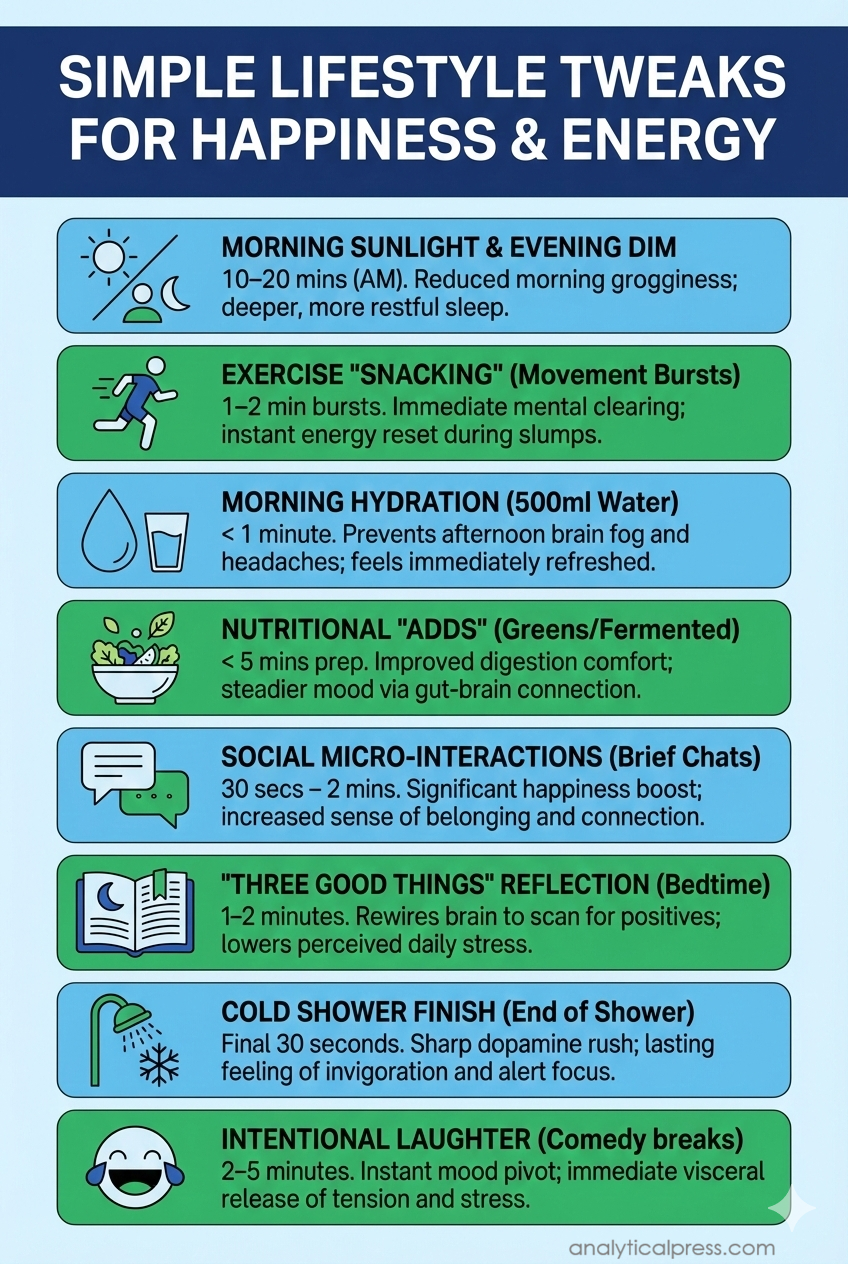
Refer to this complete infographic for an overview:
Conclusion
True health isn’t found in a bottle of expensive supplements or a grueling marathon training plan. It is found in the margins. It is the 30 seconds of cold water, the 500 ml of morning hydration, and the five minutes of laughter. These are not life-altering time commitments; they are life-enhancing rituals. By focusing on these minor changes, we move away from the “labor” of being healthy and toward the simple joy of living well.